
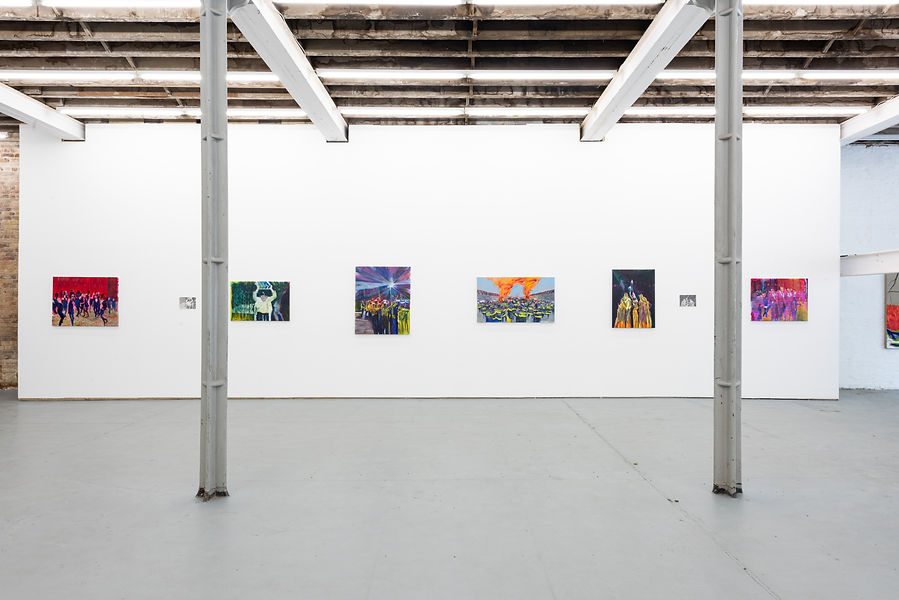
Photo credit: René Lazovy
STATEMENT
My work explores the contradiction between individualism and collectivism.
We all want to be someone—to be unique, to be recognised, to stand apart. Yet we also gather together: marching in protest, wearing the same T-shirts, chanting the same slogans. Our sense of self constantly shifts between individuality and belonging, moving back and forth like a yo-yo.
This is why I paint human bodies without emphasising individual features. Up close, the figures dissolve into rough brushstrokes. From a distance, however, they become crowds of people dancing, protesting, standing, or simply existing together.
Through these paintings, I am less interested in depicting the human body itself than in capturing what emerges between people. When we look at a crowd, we do not notice how many fingers or legs each person has. Instead, we sense solitude, anger, solidarity, envy, and countless other emotions. I want to paint those invisible feelings and the fleeting moments in which they arise.
私たちは皆、「何者かになりたい」と願っています。唯一無二の存在になりたい、認められたい、人とは違う存在になりたいと。しかしその一方で、私たちは集団にもなります。抗議デモで同じTシャツを着て行進する、同じスローガンを唱える、同じ歌を歌い、一緒に踊ります。私たちの自己意識は、個人と集団の合間を絶えず揺れ動き、まるでヨーヨーのように、行ったり来たりしています。
粗い筆致と色彩の中へと人間が溶けていくように描いていますが、遠くから見ると集団として人間が踊ったり、抗議したり、立っていたり、あるいはただ共に存在している姿が浮かび上がります。
人間の身体そのものを描写することよりも、人と人とのあいだに在るものを捉えようとしています。私たちが群衆を見るとき、一人ひとりの指が何本あるか、脚が何本あるかなど瑣末なことです。指の数を数える代わりに、孤独、怒り、連帯、嫉妬、数え切れないほどの感情が呼び起こされます。私は、そうした目には見えない感情を絵にしたいです。
BIO
Eri Ueno is a contemporary painter. Her work focuses on exploring the boundaries of humanity that can easily disappear. She holds a BA from Nagoya University of Arts. In 2019, at the beginning of her artistic career, she practiced installation, film, photography, and interviewing people who have been marginalised in Japan, such as immigrants. She was awarded a 2019 Nakagawa Canal Artist Fellowship. As the project grew, she felt an immense sense of guilt for exploiting the stories of marginalised people in the name of art. These experiences have been key for her in approaching other artistic mediums, mainly oil painting.
Ueno's paintings have been exhibited in Tokyo, Nagoya, Kagoshima and London.
上野英里は現代画家である。彼女の作品は、簡単に消えてしまう人間の境界線を探ることに重点を置いている。名古屋芸術大学卒業。2019年、芸術家としてのキャリアをスタートさせるにあたり、移民など日本で周縁化されてきた人々へのインタビューを実践。2019年度中川運河Artoc10から助成金を取得した。プロジェクトが大きくなるにつれ彼女は芸術の名の下に周縁化された人々の物語を利用することに計り知れない罪悪感を感じるようになった。これらの経験は彼女にとって油絵を中心とした他の芸術媒体にアプローチする際の鍵となり、現在は油絵を中心に制作活動をしている。上野の絵画は東京と名古屋、鹿児島、ロンドンなどで展示されている。
